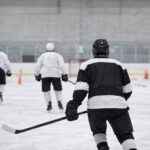
Have you long wanted to start playing hockey, but didn’t know where to begin?
Then this article is for you
Many adult men and women have been looking toward hockey for a long time but never take the first step. Some are held back by the fear that it is already too late. Others do not understand where to start at all. And others think that hockey is too difficult, too expensive, and “not for beginners.”
In reality, amateur hockey in Estonia is open to new players, and you can start even as an adult. Yes, it is a demanding and technically complex sport. But that is exactly why it is so captivating, builds character, and over time becomes an important part of life.
In this article, we will cover the main points: what equipment a beginner needs, how to prepare physically, whether personal training is necessary, how to approach sports nutrition, and where to turn if you want to try yourself in hockey.
Equipment: used or new?
Let’s be honest: hockey is not the kind of sport where you should walk into a store without thinking and say, “I want everything new and the best available.” If you have never stepped onto the ice in full gear before, you need to understand that your first purchase may turn out to be a “one-time” purchase. Sometimes a person gets excited about the idea, buys an expensive full set, and then realizes that hockey means serious physical demands, discipline, and consistency. Not everyone is ready for that.
That is why the most sensible option for starting out is a used gear set. Especially if you have never skated before or are only just beginning to understand whether you actually enjoy hockey as a process.
Why a used gear set is a good start:
- it is significantly cheaper;
- you can assemble a full set more quickly;
- you do not overpay for equipment before understanding your real needs;
- over time, you will feel for yourself exactly what you want to replace and improve.
Usually, a beginner quickly starts to understand that they want a more comfortable fit somewhere, a lighter helmet, better protection, a more suitable stick, or different skates. And that is when it already makes sense to gradually upgrade your set to suit you personally.
What to pay special attention to:
The most important and most sensitive pieces of equipment are:
- skates;
- helmet;
- stick.
These are exactly the items where you usually should not cut corners thoughtlessly.
Skates directly affect comfort, stability, skating technique, and safety. Poorly fitted skates can kill all your desire to train after your very first sessions on the ice.
A helmet is a matter of safety. It should fit well, not wobble, not press, and be in good condition. If you buy a used one, make sure to check its condition as carefully as possible.
A stick affects how the game feels, your shot, puck reception, and control. An overly expensive stick is not essential at the start, but you should not go for a completely random option either. Although personally, my expensive sticks wear out several times faster than more affordable options.
The rest of the protective gear — elbow pads, shin guards, pants, shoulder pads, gloves — is usually in примерно the same price range, and it can be assembled gradually by reasonably combining new and used items.
The main rule for a beginner:
Do not try to buy the “perfect gear” right away.
Your first task is to put together a practical, safe set and start training.
Physical preparation: why it really matters
When people come to amateur hockey at 30–35 years old, and sometimes even later, everyone has a different starting point. Some have played sports all their lives, some have only gone to the gym, some play football or ride a bicycle, and some have lived mostly sedentary lives in recent years.
And here it is important to immediately accept one idea: hockey itself will get you into shape, but entering it without a basic physical foundation is a mistake.
Hockey players are not always lean fitness models. Very often, they are dry, strong, sinewy guys capable of handling high loads, contact, sharp acceleration, and repeated short intense shifts. In simple terms, every hockey player really is “made of steel muscles” — not always big ones, but functional ones.
Why special attention should be paid to the heart and cardio
During an intense shift, a player’s heart rate can rise very high. For an unprepared person, this is a serious load. If you have not done sports for a long time, are overweight, have high blood pressure, or other health-related concerns, you need to approach hockey gradually and intelligently.
Special attention should be paid to:
- endurance;
- heart function;
- recovery after exertion;
- breathing;
- the body’s overall condition.
If you have any health concerns, it is better to have a basic medical check-up before starting intense training.
What good physical fitness gives you on the ice
Physical fitness is not just about appearance. In hockey, your body is your tool.
The better your shape, the more:
- easily you move;
- easily you maintain the pace;
- the less likely you are to “die” quickly after a short shift;
- the lower the risk of injury;
- the better your balance;
- the more stable your shot;
- the more confident you are in battles and along the boards.
It is especially important to understand that in adulthood, you can get injured literally out of nowhere: during a fall, during a sudden stop, during a poorly executed shot, or because of incorrect body mechanics.
What is worth adding alongside hockey
If you want to progress faster and feel better on the ice, the following help a lot:
- cycling;
- brisk walking;
- running or interval cardio;
- leg and core exercises;
- balance work;
- stretching and mobility;
- strength training in reasonable amounts.
And one more important point: if at the same time you reduce alcohol, excess sugar, flour-based foods, and generally review your diet, your body will begin to change quite quickly. With regular training and a sensible calorie deficit, many people lose weight almost on its own. And along with it, unnecessary stress on the joints, heart, and back also goes away.
Personal training: is it necessary?
You need to be honest: you cannot turn a complete beginner into a hockey player in one day, even an amateur one. Everything takes time. Hockey is one of the most difficult team sports in terms of coordination. At the same time, you need to skate, keep balance, read the game, work with the stick, control the puck, make decisions, and maintain a high pace.
How much time progress takes
If you simply train regularly 2–3 times a week without long breaks, good personal progress usually takes years. Roughly speaking, an amateur player reaches a noticeable peak in shape and game understanding after 3–5 years of systematic training.
That is normal.
Hockey is a marathon, not a sprint.
When a personal coach is especially useful
If you want to speed up progress, avoid common mistakes, and feel confident sooner, personal training helps a lot.
A coach can help develop:
- skating;
- stopping;
- turns;
- starting acceleration;
- shooting technique;
- puck handling;
- coordination;
- basic game habits.
Coaches are also useful for:
- general physical preparation;
- gym work;
- mobility and recovery.
Why this matters
When a person learns on their own, they often reinforce incorrect movement patterns. Later, relearning becomes much harder. That is why even a few personal sessions at the beginning can bring enormous value and save months, and sometimes even years.
The ideal option for a beginner:
- start with group training;
- at the same time take a few personal skating sessions;
- if possible, add gym work or basic off-ice conditioning.
This way, progress becomes noticeably faster and confidence grows.
Sports nutrition and supplements: does an amateur need them?
When you start training regularly, your body will quickly show what it is lacking. Some people will lose weight rapidly, others, on the contrary, will realize that they lack muscle mass, strength, and recovery. Some will feel that it is hard to maintain intensity or recover for a long time after games and practices.
This is exactly when many people begin to take an interest in sports nutrition.
What is important to understand
Sports nutrition is not magic and not a substitute for training.
It only works when you already have:
- regular physical нагрузка;
- a routine;
- a more or less structured diet;
- sleep and recovery.
What may be relevant for amateurs
Depending on your goals, these may include:
- protein supplements;
- isotonic drinks;
- electrolytes;
- vitamins and minerals;
- recovery supplements;
- products for gaining mass or maintaining weight.
But here is the key point: if you have health issues, chronic diseases, blood pressure concerns, heart-related conditions, gastrointestinal issues, or any doubts at all, it is better to consult a doctor.
This is especially important for adult players who come to hockey not at 16, but at a mature age.
What matters more than any supplements
Before any supplements or sports nutrition, you first need to establish:
- your regular diet;
- hydration;
- sleep;
- recovery;
- basic discipline.
Without that, no container of supplements will make you stronger on the ice.
The psychological barrier: the main opponent is not the ice, but doubt
Many potential players do not start not because they cannot, but because they are afraid of looking weak, awkward, or ridiculous. It may seem that everyone around already knows how to skate, understands everything, and that you will be “out of place.”
In practice, almost every beginner goes through this.
It is important to understand:
in amateur hockey, no one is waiting for you as a ready-made player — they are waiting for you as a person who wants to start.
In the end, it is desire, consistency, and readiness to learn that produce results.
Yes, at first it will be hard. Yes, at first things will not work out. Yes, after your first practices, you may realize that hockey is much harder than it looked from the outside. But that is exactly where its value lies.
What beginners often forget
Besides equipment and training, there are several more things worth knowing in advance.
It is important not to rush
You do not need to try to do everything at maximum effort right away. It is better to progress gradually than to overload yourself in the first weeks and then be out for a month because of injury or overtraining.
Recovery is part of progress
Sleep, water, rest, proper nutrition, a warm-up before the ice, and a light cool-down after training really do affect your results.
Hockey is about consistency
One practice session per month will give you almost nothing. Even if you are highly motivated, results come through a system: 2–3 sessions per week, without long pauses.
Equipment must fit comfortably
It does not have to be expensive, but it must be safe and comfortable. Skates that rub, a loose helmet, and uncomfortable gloves can ruin your entire start.
Do not compare yourself to those who have been in hockey for 10 years
Your only reference point is yourself one month ago.
How much does it cost to start playing hockey in Estonia?
One of the first questions almost every beginner asks is:
How much does amateur hockey actually cost?
Let’s be honest — it is not the cheapest sport. But it is also not as expensive as many people imagine, especially if you start without unnecessary purchases and enter the process gradually.
How much equipment costs
The most reasonable option for a beginner is to start with a used set of gear.
Used equipment:
approximately 200 – 600 €
New equipment:
approximately 1200 – 2500 €
It is important to understand:
There is no need to buy everything new right away.
Most players build their gear set gradually. First the basic set, then over time individual items are upgraded.
The most expensive items are:
- skates
- helmet
- stick
The rest of the protective gear usually costs about the same.
The optimal approach:
Assemble a reliable set → start training → understand your needs → gradually improve your equipment.
How much it costs to play
The main recurring expense is ice time.
On average:
One training session:
5 – 20 €
Monthly fee (training and games):
approximately 100 – 150 €
Sometimes a little more, if the team trains more often.
In essence, this is comparable to an active hobby or a good fitness club membership.
Additional expenses
There are also related expenses that appear over time:
Skate sharpening:
8 – 15 €
Tape for the stick:
5 – 15 €
Personal training sessions (optional):
from 30 € per session
Gym membership:
25 – 70 € per month
These are not mandatory expenses, but they help you progress faster.
What else is important to know in advance
There are also additional expenses that people rarely think about at the start, but they do exist.
For example:
Away games:
- fuel or transport
- sometimes accommodation
- meals
Insurance:
- many players take out sports insurance
- especially if they play regularly
Recovery and treatment:
- massage
- physiotherapy
- treatment of minor injuries
- taping
It is also important to consider a simple everyday factor:
hockey takes time.
This means:
- evening training sessions
- games on weekends
- travel to other cities
For players with families, this is always a matter of balancing sport, work, and family life.
The real picture of expenses
If you look at it objectively:
The first year:
Equipment:
500 – 1200 €
Games and training:
1000 – 1500 €
Total:
approximately 1500 – 2500 €
After that, expenses become more stable:
Usually:
100 – 150 € per month
or:
approximately 1000 – 1500 € per year
What is important to understand
Players rarely see hockey as just an expense.
Over time, it becomes part of life because it gives:
- physical fitness
- a strong community
- emotional release
- competitive excitement
- new connections
Can you start more cheaply?
Yes.
If you approach it wisely, you can:
- choose equipment without overpaying;
- avoid buying unnecessary things;
- choose a team that fits your budget;
- understand the real costs in advance.
In some cases, it is possible to start from around 600 – 800 € if you build the set gradually.
The main thing
You do not have to start perfectly.
You simply need to take the first step.
Everything else comes with experience.
Where should you turn if you want to start?
This is probably the most important part.
If you have wanted to try hockey for a long time, you do not need to figure everything out on your own. We are open to new players and ready to help make this path much easier for you.
You can:
- contact our clubs directly;
- write to us at info@hokiliiga.ee;
- tell us a little about yourself: your age, skating experience, city, whether you already have gear, and whether you simply want to try or are already ready to train systematically.
We will help you:
- find a suitable club;
- connect you with coaches;
- explain where to start;
- help you understand the equipment;
- guide you through your first steps in amateur hockey.
Our task is not just to reply to your email, but to help you actually take your first step onto the ice.
Conclusion
Starting to play hockey as an adult is real.
Yes, it requires time, patience, and effort.
Yes, it is not the easiest sport.
But that is exactly why it changes a person so deeply.
Start wisely:
- do not spend unnecessary money on expensive equipment right away;
- pay attention to your heart, cardio, and overall physical condition;
- do not be afraid to take personal training sessions;
- approach nutrition and recovery consciously;
- do not hesitate to ask for help.
The most important thing is not to wait for the perfect moment.
In hockey, as in many things in life, progress begins with the first step.
Want to give it a try? Write to us at info@hokiliiga.ee — and we will help you get started.